Why Website Authenticity Matters More Than Ever
There has been a quiet shift in how websites are being ranked.
For a long time, the conversation around SEO focused on keywords, formatting, and technical optimization. Those things still matter, but they are no longer the whole story. What Google is increasingly trying to understand is something much more human: is this real?
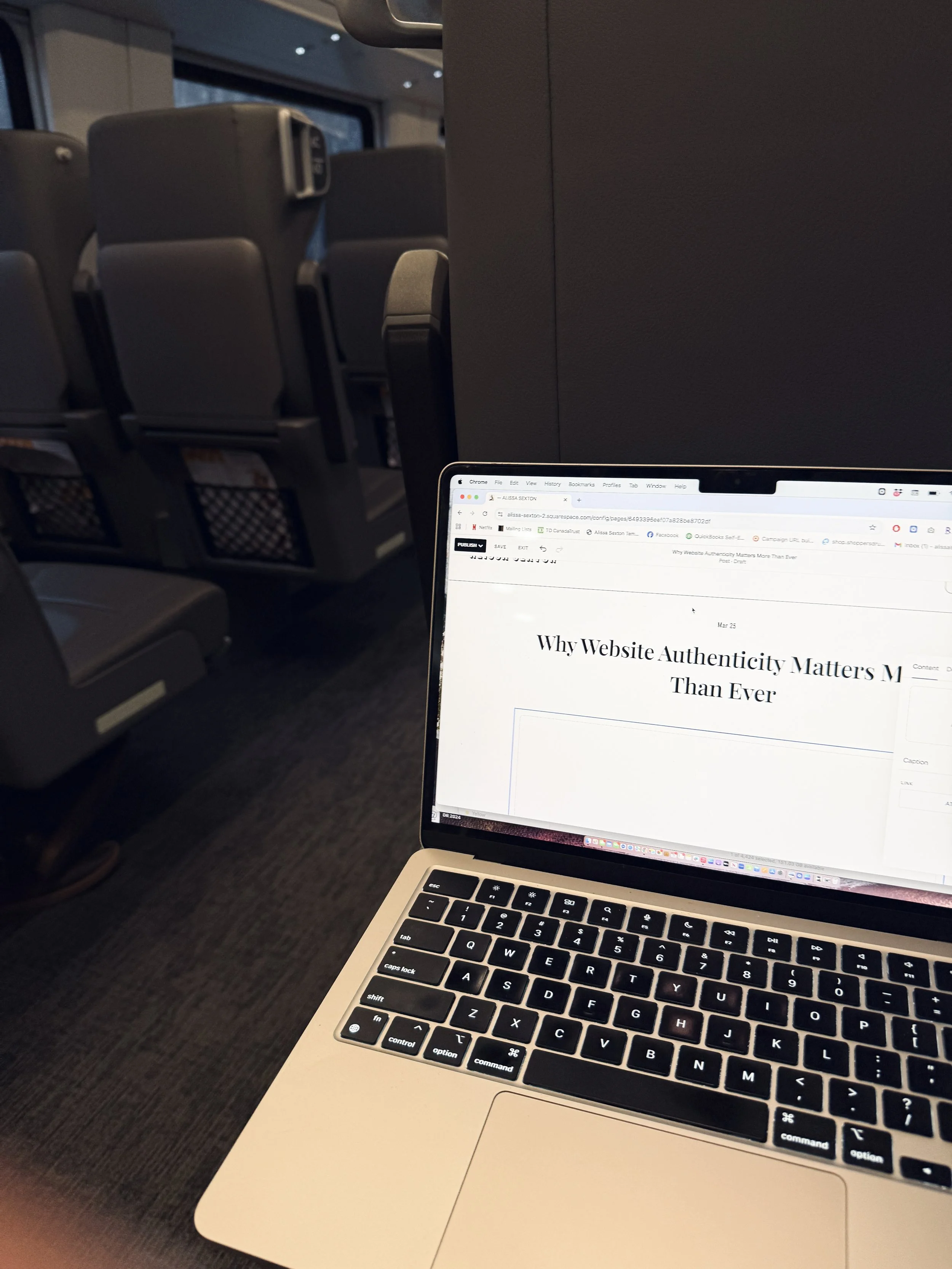
To show you how real I am, I’ll share that I wrote this blog post while on a train! 😊
This shift has become more pronounced as AI-generated content has flooded the internet. It is now easier than ever to produce something that reads well, looks professional, and says all the “right” things. But in response, Google has adjusted what it prioritizes. It is no longer just evaluating how well something is written. It is looking for signs that the content comes from lived experience, clear perspective, and actual expertise.
This is where authenticity moves from being a personal value to a practical strategy.
From “Optimized” to “Proven”
Google’s framework for evaluating content is often referred to as E-E-A-T: Experience, Expertise, Authoritativeness, and Trustworthiness.
What matters most here, especially for artists, is the first word: experience.
Google is trying to determine whether the person behind the content has actually done the thing they are talking about. This is something AI cannot convincingly replicate. It can imitate tone and structure, but it cannot provide real, grounded insight.
You can feel the difference when you read it. And increasingly, so can search engines.
This means that the goal is no longer to create the most “optimized” website. It is to create a website that feels proven. One that shows evidence of a real practice, a real perspective, and a real person behind the work.
What Authenticity Looks Like to Google
Authenticity is not a single feature you can add. It shows up through a collection of signals across your site.
One of the most important is first-hand experience. When you speak directly about your process, your decisions, or the reasons behind your work, you are demonstrating something that cannot be generated generically. Even a simple sentence about how a painting came together, or what was happening in your life when you made it, adds depth that is difficult to replicate.
Another key signal is clear identity. Google is looking for evidence that there is a real person behind the website. This includes your About page, your bio, your presence across platforms, and even the consistency of your voice. When everything aligns, it builds trust.
There is also a strong emphasis on originality. Content that feels generic, even if it is well written, tends to underperform. This is especially noticeable in artist statements that rely on familiar phrasing without offering anything specific. The more your language reflects your actual way of thinking and speaking, the more distinct your site becomes.
Specificity plays a major role as well. Details matter. Mentioning materials, locations, or moments of decision-making gives your work context. It shows that your practice exists in a real, tangible way.
And then there are engagement signals, which are often overlooked. Google pays attention to how people behave on your site. Do they stay and read? Do they click through multiple pages? Do they come back? These behaviours indicate that something on your site is resonating. Authenticity plays a direct role here, because people tend to spend more time with content that feels genuine and grounded.
Where Location Fits In
Location can be a factor, but it is not the main driver.
If your work is tied to a place, such as a city, region, or landscape, including that context can help with visibility, particularly for local searches. It can also add another layer of specificity to your practice.
But location alone does not create authenticity. It is simply one of many signals. A highly generic website with a clear location will still feel flat, while a deeply personal and specific site without a strong location signal can still perform very well.
Why This Matters for Artists
This shift actually works in your favour.
You are already doing something that is inherently difficult to replicate. You are making decisions, responding to materials, working through ideas, and building a body of work over time. That is exactly the kind of depth Google is trying to surface.
The challenge is not creating authenticity. It is allowing it to be visible.
Many artist websites unintentionally smooth over the very details that make the work compelling. In an effort to sound professional, they remove the specificity, the personal language, and the small moments that create connection.
But those are the elements that now carry weight, both with people and with search engines.
A Useful Way to Think About It
The same things that make someone trust your work as a collector are the things that help Google trust your website.
Clarity. Specificity. Presence. A sense that there is a real person here, making real decisions.
You do not need to compete with highly polished, AI-generated content. In many ways, that kind of content is becoming easier to ignore.
What stands out now is something quieter and more grounded. A voice that feels like it belongs to someone. A website that reflects an actual practice, not just a presentation.
Authenticity Checklist
☐ Read your About page out loud
Does it sound like how you actually speak? If not, rewrite one paragraph in your natural voice.
☐ Replace one vague sentence
Look for phrases that could apply to any artist. Swap one out for something specific and personal.
☐ Add one real detail about your process
Mention a material, a habit, or a moment that shapes how you work.
☐ Refine your artist statement
Remove one generic phrase and replace it with something only you could say.
☐ Show a glimpse behind the scenes
Add a studio photo, work in progress, or a small note about how a piece came together.
☐ Make your identity clear
Ensure your name, face, and presence are easy to find and feel consistent across your site.
☐ Add context to your artwork pages
Give just enough information so viewers understand what they are looking at and why it matters.
☐ Soften your contact page
Make it feel open and human, not just functional. A single sentence can shift the tone.
☐ Check for overly polished language
Notice where your site feels generic or “perfect.” These are often the best places to add personality.
☐ Keep it simple
You do not need to change everything. One or two thoughtful updates can make a meaningful difference.
Do you need help with this?
I have designed hundreds of artist websites over the years, and the way I approach them has evolved alongside the technology.
What has been most interesting is that this current shift, away from perfection and toward something more real, feels the most aligned with how artists actually work and think. It feels more honest, and ultimately more effective.
When I design websites now, I am not just thinking about layout and functionality. I am thinking about how to make the artist’s voice visible, how to bring forward the details that create connection, and how to build a site that feels grounded in a real practice.
That is something I intentionally infuse into every website I create. And, as a curator I can also help you discuss and develop this content while we design the site.
If you are feeling like your current site is not quite reflecting you, or you are starting from scratch and want to get it right from the beginning, you can learn more about working together here.